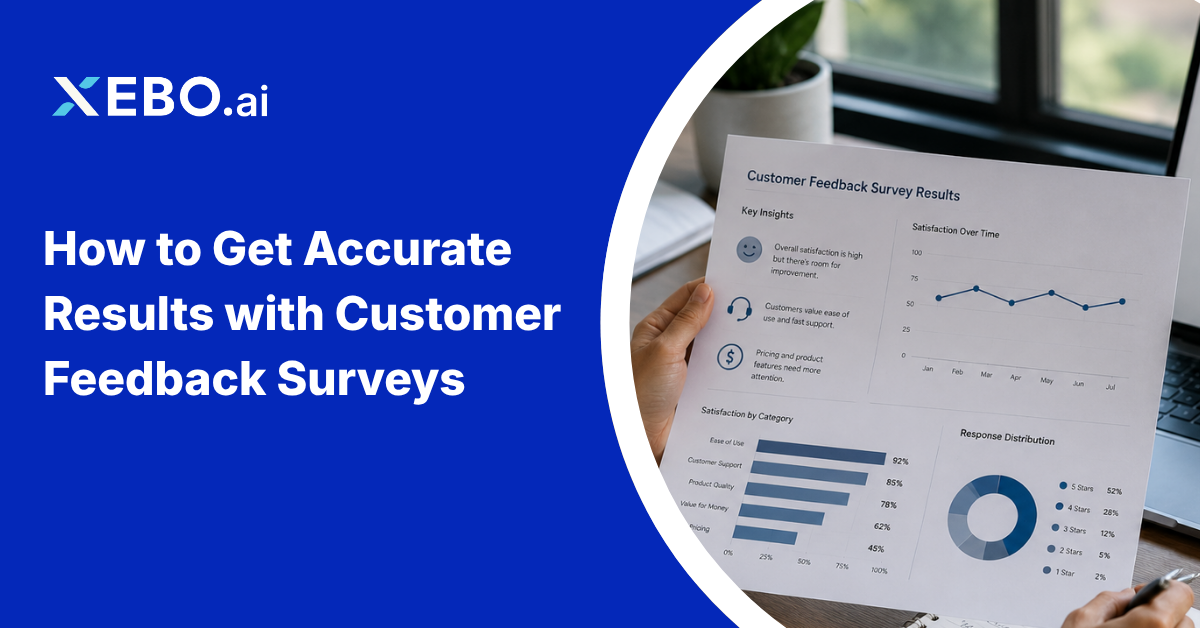
Customer feedback surveys are one of the most powerful tools organizations use to understand customer needs, improve experiences, and drive business growth. However, collecting feedback is only half the battle. The real challenge lies in obtaining accurate, reliable, and actionable insights.
Many businesses invest heavily in survey programs only to discover that their data is incomplete, biased, or difficult to interpret. Poor survey design, low response rates, and untimely feedback collection can lead to misleading conclusions and costly business decisions.
The good news is that with the right strategy and technology, organizations can dramatically improve the accuracy of their customer feedback surveys and uncover insights that truly reflect customer sentiment.
Before creating a survey, define exactly what you want to learn.
Are you measuring customer satisfaction? Understanding product feedback? Evaluating customer service interactions? Tracking loyalty and retention?
When survey objectives are unclear, questionnaires often become too long, ask irrelevant questions, and produce data that lacks focus. Every survey should have a specific purpose and a clear plan for how the collected information will be used.
Organizations that begin with well-defined goals are more likely to gather meaningful responses and generate actionable insights.
The technology behind your survey program plays a critical role in data accuracy.
Modern Voice of Customer (VoC) platforms such as XEBO.ai help businesses collect feedback across multiple touchpoints, analyze responses in real time, and uncover hidden trends using artificial intelligence.
Unlike traditional survey tools that simply gather responses, XEBO.ai enables organizations to:
By leveraging intelligent survey technology, businesses can significantly improve both response quality and data reliability.
One of the biggest reasons surveys produce inaccurate results is poorly written questions.
Customers should immediately understand what is being asked without needing clarification. Complex language, technical jargon, and leading questions can influence responses and distort findings.
For example:
Instead of asking:
"How satisfied are you with our industry-leading customer support experience?"
Ask:
"How satisfied are you with the support you received today?"
Neutral and straightforward wording encourages honest feedback and reduces response bias.
Keep Surveys Short and Relevant
When customers are presented with lengthy questionnaires, they often abandon the survey or rush through answers without careful consideration.
The most effective customer feedback surveys focus only on essential questions. Every question should contribute directly to the survey's objective.
As a general rule:
Shorter surveys consistently generate higher completion rates and more thoughtful responses.
Timing can significantly impact response accuracy.
The closer a survey is delivered to a customer interaction, the more accurate the feedback tends to be. Customers can better recall their experiences and provide more detailed insights.
For example:
Journey-based survey automation ensures feedback is gathered while experiences are still fresh in customers' minds.
Customers are more likely to engage with surveys that feel relevant to them.
Instead of sending the same questionnaire to every customer, use customer data to personalize questions based on their interactions, purchase history, location, or journey stage.
Personalized surveys improve engagement, increase completion rates, and produce more accurate responses because customers feel the questions directly relate to their experiences.
Not all customers prefer the same communication channel.
Some may respond to email surveys, while others prefer SMS, mobile apps, websites, QR codes, or messaging platforms.
A multi-channel feedback strategy helps capture a broader and more representative sample of customer opinions.
Organizations that collect feedback across multiple touchpoints gain a more complete view of the customer experience and reduce sampling bias.
Customers should feel comfortable sharing both positive and negative experiences.
Avoid making surveys feel like evaluations or sales opportunities. Assure respondents that their feedback is valued and will be used to improve services.
Anonymous feedback options can also increase response honesty, particularly when collecting employee experience or sensitive customer feedback.
While rating scales provide useful metrics, the most valuable insights often come from open-text comments.
The challenge is that manually analyzing thousands of comments is time-consuming and prone to human error.
AI-powered platforms like XEBO.ai automatically analyze customer comments, identify themes, detect sentiment, and highlight emerging issues in real time.
This allows organizations to move beyond scores and understand the true reasons behind customer satisfaction or dissatisfaction.
Collecting feedback is not a one-time activity.
Businesses should continuously monitor response patterns, completion rates, survey drop-off points, and data consistency.
Watch for signs of poor data quality such as:
Regular monitoring helps maintain survey accuracy and ensures decision-makers can trust the insights being generated.
Customers appreciate knowing their feedback has been heard.
Following up on customer concerns, sharing improvements, and demonstrating action based on survey results can significantly improve future participation rates.
When customers see real change resulting from their feedback, they become more engaged and provide more thoughtful responses in future surveys.
Closing the loop transforms surveys from a simple data collection exercise into a powerful customer engagement strategy.
As customer expectations continue to evolve, organizations need more than traditional survey tools. They need intelligent systems that can capture feedback across channels, analyze insights instantly, and turn customer voices into business action.
Accurate customer feedback surveys are not just about asking questions—they are about collecting the right feedback from the right customers at the right time and transforming it into meaningful improvements.
Businesses that master this process gain a competitive advantage through stronger customer relationships, higher satisfaction, and more informed decision-making.
If you're looking to collect more accurate customer feedback, uncover deeper insights, and act faster, XEBO.ai can help.
With AI-powered survey management, Voice of Customer analytics, journey-based feedback collection, and real-time reporting, XEBO.ai empowers organizations to transform customer feedback into measurable business outcomes.
Schedule a Free Demo with XEBO.ai today and discover how intelligent customer feedback management can help you deliver exceptional customer experiences.
Survey results can become inaccurate due to leading questions, poor survey design, low response rates, survey fatigue, biased sampling, and delayed feedback collection.
Most customer surveys should contain between 5 and 10 questions. Shorter surveys typically achieve higher completion rates and more reliable responses.
The best time is immediately after a customer interaction, purchase, support request, or service experience while the event is still fresh in the customer's memory.
AI can automatically analyze customer comments, identify sentiment, detect recurring themes, uncover emerging issues, and generate actionable insights much faster than manual analysis.
Open-ended questions allow customers to explain their experiences in their own words, providing deeper insights into the reasons behind satisfaction or dissatisfaction.
XEBO.ai uses AI-powered analytics, journey-based survey automation, multi-channel feedback collection, and real-time reporting to help organizations gather more accurate and actionable customer insights.
While response rates vary by industry, customer feedback surveys typically perform well when response rates exceed 20%. Higher engagement often indicates better survey relevance and customer trust.
Yes. Organizations that actively collect, analyze, and act on customer feedback often improve satisfaction, loyalty, and retention by addressing issues before they lead to customer churn.